
Overview
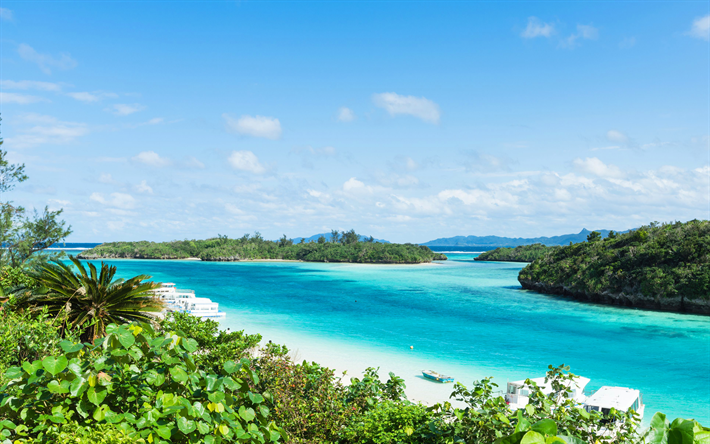
Located between the East China Sea, the Pacific Ocean, and the Philippine Sea are the islands of Okinawa Prefecture. With a subtropical climate, Okinawa has an average temperature of 22°C (72°F) with mid to high humidity levels. In the summer months, the combination of high humidity with temperatures around 30°C (88°F) make for miserably hot weather. In the winter months, the temperature does not usually fall below 10°C (50°F). However, it can feel fairly cold because of strong northern winds whipping over the ocean and frequent cloudy days.
Hot Weather Season
Depending on the climate to which you are accustomed, the weather in Okinawa can be an uncomfortable adjustment. While you may find that the heat does not bother you, the high humidity levels can be challenging.
July and August
- The hottest months of the year, July and August usually average 32°C (90°F) with humidity levels of 80-90%.
- While July and August are usually the hottest months of the year, expect hot, humid weather from May through October.
Air Conditioning
- In order to combat the heat, most apartments are equipped with an AC unit. If you find yourself having to buy a new AC unit, it may cost around ¥50,000 or more.
- In addition to your apartment, schools generally have air conditioning, although they may limit the usage to days with extremely high temperatures. Even then, cooling might be limited to certain rooms.
Clothing
- During summer, many Okinawans choose to wear kariyushi shirts. These shirts can be easily obtained in most department stores in Okinawa, though they can be a little expensive.
- For further recommendations and information regarding clothing, please check Pre-Arrival.
For further information about preparing for summer, please visit this page: Combating Summer.
Cold Weather Season
As buildings are designed to withstand the heat of summer, the chill of winter can penetrate buildings quite easily. The strong winds of winter also contribute to a sense of chilliness that is not necessarily reflected in the air temperature. While Okinawa may not experience snow or sleet, even those from countries with proper winters may find this season to be colder than they expect.
January and February
- The coldest months of the year, January and February usually average 17°C (62°F) with humidity levels of 60-70%.
Heating
- Central heating is generally nonexistent. Many JETs invest in a small electric heater to use at home.
- While some workplaces may also have a heater, the majority will not. Be prepared to dress warmly.
Dryness
- While the winter months may see some rain, the humidity will decrease, causing both dry skin and coughing as a result of the dry air.
In Between Weather Season
Unlike the majority of Japan, Okinawa does not have well-defined autumn and spring seasons. These seasons tend to be unpredictable in both timing and weather. While autumn generally falls in November and December, it can start as early as October. Spring is much the same–sometimes starting as early as February. Both seasons are prone to changeable weather where the day may start sunny before quickly changing to rain. This change in weather can also be seen between areas and cities–an occurrence Okinawans describe with the word katabui (カタブイ).
November and December
- In between the mugginess of summer and the cold winds of winter, Okinawa experiences a short autumn. Temperatures in these months sit in the low twenties (around 70°F) with humidity in the low 70% range.
March and April
- After a cold winter comes a short spring. Much like autumn, spring temperatures sit in the low twenties (around 70°F); however, spring tends to be a bit more humid at around 80%.
Clothing
- During these seasons, layers are helpful. It is not uncommon to see a mix of lightweight windbreakers/sweaters and short-sleeved shirts. For specific recommendations, please check Pre-Arrival.
Rainy Season
A season characterized by persistent clouds and rain showers, tsuyu (つゆ 梅雨; also pronounced as baiu) starts early in Okinawa. While many lament having to shelter inside, the rainy season is the last break in weather before a long and intense summer.
May and June
- Lasting around a month, tsuyu generally falls between May and June each year. Temperatures for these months fall between 24°C and 26°C (75°F and 80°F) with humidity levels reaching as high as 90%.
Preparation
- Many of the tips discussed in Combating Summer also apply to the rainy season. Before leaving your apartment for the day, be cautious about leaving any doors and windows open. All supermarkets and drugstores sell dehumidifiers by the pack. You may find that some of your windows/doors can collect condensation. Placing a towel or tray under such places can help to prevent water damage to your apartment.
Typhoon Season
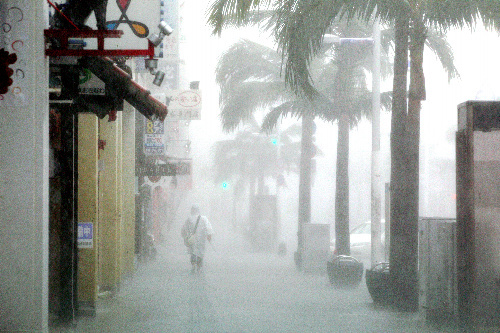
Typhoons are tropical storms that form in the ocean and can make landfall. While typhoons can be quite severe, the majority of typhoons tend to be weak and/or never approach land.
May through September
- Some typhoons approach as early as May; however, most typhoons come during the months of June, July, and August.
Weather
- During a typhoon, the temperature does not fluctuate much from the norm, but, with the rain, the humidity does increase to that of 90 to 100%. Additionally, typhoons can cause power outages, meaning that you may find yourself without the use of air conditioning and fans. Try to keep yourself as cool and hydrated as possible during times of high humidity.
For further information about typhoon preparations, please visit this page: Typhoon Preparation.
 Okijets