Staying in Japan After JET

*No matter what your situation is, we recommend getting in contact with the Japan Immigration Bureau (there is a branch in Naha) to explain your situation and assure that you are doing the correct procedures.

1. Job-hunting
CLAIR hosts the After JET Conference and Career Forum in the Kanto area around February – March of each year. They send out reminder emails from a couple months beforehand and you will need to register in order to be able to attend. You are generally required to take nenkyu during this time and must cover all expenses yourself.
There are several other CLAIR career forums held at different times in different parts of the country. Please refer to the CLAIR website for more details regarding the career forums.

There are several online job databases:
Daijob
Indeed
Wantedly
Etc.

2. Status of Residence/Visas
In order to be able to continue to reside in Japan, you will need a valid visa, which in this case will most likely be a working visa.
ALTs’ status of residence as detailed on their 在留カード (zairyuu kaado, residence card) and visas is “Instructor.”
CIRs’ status of residence is “Engineer/Specialist in Humanities/International Services.”

If your next job falls under the same designation (i.e. ALT → English instructor ≪or≫ CIR → translator/interpreter), then you can continue on to your next place of employment while continuing to work under the same visa (as long as it has more than 3 months left until expiration). You can find a list of status of residences along with examples on the Immigration Bureau’s website.

If your next job does NOT fall under the same classification (i.e. ALT → translator/interpreter), then you need to apply for a change for status of residence. We recommend doing this as soon as you have finalized your next job.
You can find an explanation of changing the status of residence on the Immigration Bureau’s website.

You will need to register that you have started a new job with the Immigration Bureau after your first day of work. This registration can be done online at the link below:

GOING TO YOUR NEW MUNICIPAL OFFICE
What you need:
在留カード (zairyuu kaado, residence card)
Passport
Money

3. Registering a New Address
If you are leaving your current address, you will need to register your new one with the local government office.
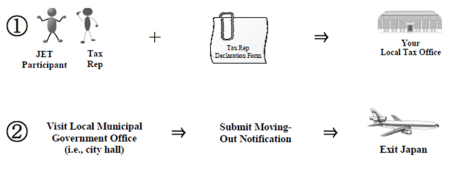
Before leaving, you need to visit your local city/town/village hall and fill out paperwork notifying them that you will no longer be residing at the same address. It is called 転出届 (tenshutsu todoke), and it is recommended that you submit it within two weeks of departure.
You will need to fill in your current address, your new address, and the day you are moving out. This will most likely be processed at the 市民課 (shiminka, Citizen Division).

When you reach your new local government office, you will turn in a 転入届 (ten’nyuu todoke) to register your new address. You must submit this within 14 days of moving to the new location.
When you arrive at the new government office, head to the 市民課 and take a number. When your number is called you will fill in the 転入届 with your new address, old address, and the day you move in. They will ask you to confirm the information is correct, and if you have a spouse or child you may be asked to provide proof (i.e. marriage license, birth certificate, etc. *They may also request a translated copy, but depending on the government office you can have anyone translate it and do not need to pay for a professional translation.)
They will take your residence card so that they can write your new address on the back, and may ask if you want a 住民票 (juumin hyō, Certificate of Residency). The Certificate of Residency can be used for many bureaucratic procedures such as getting a driver’s license, and it costs around \300.

4. Pension and National Health Insurance
If you are a resident of Japan that is over 18 years old, you are legally required to pay into the national pension and health insurance systems.
This is automatically deducted from your JET pay and will most likely be a part of the terms and conditions of your new job (please check with your new workplace). However, if you are not starting work immediately after finishing JET, you are technically “unemployed” and need to enroll in the national pension and health insurance systems during this time. You lose access to the pension and health insurance when your contract ends, and therefore need to enroll in the national system during this time, no matter how long.

You will need to collect two documents from your workplace:
離職票 (rishokuhyō, Certificate of Unemployment) *Only able to receive the rishokuhyō AFTER your contract finishes.
資格喪失証明書 (shikaku sōshitsu shōmeisho, Certificate of Losing Qualification for Health Insurance)

The rishokuhyō is proof that you are currently unemployed. By providing proof of this, it essentially shows that you are unable to afford to pay in to the pension system, and therefore you may be exempt from being billed. This document is not required, but it will make the process shorter and easier and may also help avoid unwanted pension bills from appearing in your mailbox.

Similarly to the pension, you will need to be enrolled in the national health insurance during the time you are technically “unemployed.” You NEED your shikaku sōshitsu shōmeisho in order to complete the paperwork at your new municipality. With this, you can potentially get your health insurance card on the same day.
Once you begin work (and your workplace offers insurance), you will need to go back to your municipal office in person to inform them that you have switched over to the social insurance.

5. Taxes
You will be paying your current municipalities taxes until the next fiscal year (you will not be doubly taxed). Taxes are based on the previous fiscal year, which means that you will be paying the same amount of tax regardless of your next salary.
Taxes are evaluated in January, so the amount that you are charged will depend on where you live and how much you are being paid during that time. If you lived in Okinawa in January and are making X amount of money, then that is how much you will be charged until the next fiscal year. If you moved any time after January and establish your residency, your future taxes will be calculated based on where you are/how much you are making.
You may be asked by your workplace for information about your next workplace in order to fill in a 給与支払報告・特別徴収にかかる給与所得者異動届出書 (Kyuuyo Shiharai Hōkoku/Tokubetsu Chōshuu ni Kakaru Kyuuyo Shotokusha Idō Todokedesho). By filling this out and sending it to your next workplace, your future employer will know how much to deduct from your salary to automatically cover your municipal taxes. You will have to pay these no matter what, and if you do not establish a way for them to be deducted automatically, you will be sent a bill(s) that you will have to pay off instead. In order to fill this out, please know your new address, your new employer’s address, and your personal number on your MyNumber Card.
Pension Refund

For all you JETs who are returning home, the words “pension refund” may conjure images of bewilderment and complexity. However, with a little research on your part, the process can be clear and not terribly painful. Besides this article, there is more information on the JET Programme website regarding pension, in the After JET Guide Okinawa Supplement, and on the Japan Pension Service website.


Eligibility

  • Submit your Application for the Lump-sum Withdrawal Payments within two years of leaving Japan
  • Not in possession of Japanese citizenship
  • Paid Employees’ Pension Insurance premium for six months or more
  • No place of residence in Japan (submitted a moving-out notification before leaving Japan)
  • Never qualified for pension benefits (including Disability Allowance)

BEFORE LEAVING JAPAN

1. Designate a Tax Representative

  • Go to your local tax office (see list of Okinawa offices below) and get the Tax Representative Designation Form (Nozei Kanrinin no Todokesho / 納税管理人の届け書) or download a copy from the National Tax Agency website. (You can find a translation of the Tax Representative Designation Form here)
  • Find someone to be your tax representative. This does not need to be your supervisor. You can ask a fellow teacher, friend or even another JET who will still be in Japan. The tax representative must be a resident of Japan, but does not have to be Japanese. Note that your tax representative will probably need to take nenkyu to visit the tax office on your behalf so please choose wisely and be appreciative.
  • Fill out the Form with your tax representative and turn it in. The tax offices ask that you fill out 2 copies of the form: one to turn in, then another for your tax representative to keep.
  • Local Tax Offices in Okinawa: For pictures and maps in Japanese please see the website for the Japanese National Tax Agency (Japanese Only)

Naha Tax Office (那覇税務署)
Covers: Parts of Naha (Akamine, Izumisaki, Oroku, Kumoji, Matsuyama), Itoman, Tomigusuku, Nanjo, Yonabaru, Haebaru, Yaese
9 Asahimachi, Naha (across from Naha Bus Terminal)
Tel: 098(867)3101

Kita-Naha Tax Office (北那覇税務署)
Covers: Part of Naha (Shuri, Omoromachi, Mekaru, Naminoue, Hantagawa, Makabi, Mihara, Furujima) Urasoe, Nishihara, Kume-jima, Tokashiki, Zamami, Aguni, Tonaki, Minami Daito, Kita Daito
5-6-12 Miyagi Urasoe City (near Urasoe Tsutaya)
Tel: 098-877-1324
Outer Islanders: call ahead of time and see if forms can be sent by post.

Okinawa City Tax Office (沖縄市税務署)
Covers: Okinawa City, Ginowan, Uruma, Nakagami (Nakagusuku, Kitanakagusuku, Kadena, Chatan, Yomitan)
2-1-1 Higashi, Okinawa City (next to Town Plaza, Misato)
Tel: 098-938-0031

Nago Tax Office (名護税務署)
Covers: Nago, Kunigami, Ogimi, Higashi, Nakijin, Motobu, Onna, Ginoza, Kin, Ie-jima, Iheya, Izena
4-10-1 Agarie Nago City (across from Nago Post Office)
Tel: 0980-52-2920

Miyako Tax Office (宮古島税務署)
Covers: Miyako-jima, Tarama
807-7 HiraraHigasinakasone Miyakojima City (next to Kenristu Miyako Hospital)
Tel: 0980-72-4874

Ishigaki Tax Office (石垣税務署)
Covers: Ishigaki-shi, Yaeyama (Taketomi, Yonaguni)
8 Tonoshiro Ishigaki City Okinawa
Tel: 0980-82-3074

2a. Fill out the Lump-Sum Withdrawal Payment Form

  • Download (or print out before you leave) a copy of the Lump-Sum Withdrawal Payment Form from the Japan Pension Service website. In section 4, you are able to designate your home bank account (non-Japanese account) to receive your pension refund. Your tax refund on your pension however must be deposited into a Japanese bank account (does not need to be your own).

AFTER LEAVING JAPAN

2b. Mail the Lump-Sum Withdrawal Payment Form

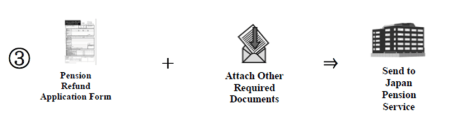
  • Mail your completed Lump-Sum Withdrawal Payment Form to the Japanese Social Insurance Agency.
  • Necessary Documents:
    • Pension Book (blue book)
    • Copy of your passport showing your Status of Residence, date of your final departure from Japan, and page showing your name, date of birth, nationality and signature
    • Bank Document verifying your bank’s name, branch office name, branch address, bank account number, and full name of the account holder (must be your name)
  • Japanese Social Insurance Agency Address
  • Japan Pension Service
  • 3-5-24 Takaido-nishi
  • Suginami-ku, Tokyo 168-8505
  • JAPAN

3. Receive Lump-Sum Withdrawal Payment Confirmation Notice

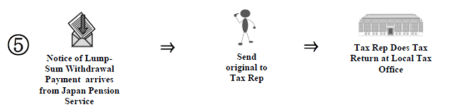
  • After you receive the first 80% of the refund, a Lump-Sum Withdrawal Payment Confirmation Notice (Dattai Ichijikin Shikyu Kettei Tsuchisho) will arrive at your address in your home country.

4. Mail Confirmation Notice to Tax Representative

  • Send the original Lump-Sum Withdrawal Payment Confirmation Notice to your Tax Representative (keep a copy for your records)

5. Tax Representative Files for a Tax Return

  • Have your Tax Representative go to the same Tax Office you went to before departing Japan and file for a tax return (kakutei shinkokushou)

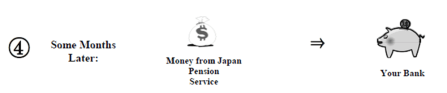
6. Tax Representative Receives Pension Tax Refund

  • The refund will be deposited into your account or Tax Representative’s bank account in Japan.

7. Tax Representative Sends Pension Tax Refund to You

  • Have your Tax Representative transfer the amount to you either through the post office, Golloyd’s, or whichever remittance method you prefer.

Frequently Asked Questions

Q: How much is my Pension Refund?
A: The amount refunded is calculated based on a person’s remuneration, rate period and period of coverage. Because it based on your average gross monthly salary it will differ from person to person. To calculate your amount please refer to the Japan Pension Service website.

The formula to calculate your amount is: Payment Amount = Your Average Standard Monthly Remuneration (ASR) x Your Multiplier

Q: I forgot to designate a Tax Representative before I left Japan, can I still designate one?
A: Yes. You can file it when making your claim for a tax refund. You do not need to be there to submit the Tax Representative Designation Form. You can fill in the form and submit it to your Tax Representative in Okinawa, have them fill in the needed portions and have them turn it in when they file for your tax refund.

Q: I noticed the Japan Pension Service site only list refund amounts for up to 36 months of enrollment. Does the amount continue to increase beyond 36 months?
A: No, you can only have up to 36 months worth of pension payments refunded. This is not a JET Programme rule, but their regulation.

Q: How much percent of my Pension Refund is taxed?
A: 20%

Q: I’m staying in Japan after JET, can I file for my refund from Japan?
A: No, you cannot. You are only eligible for the refund after you have submitted your Moving-Out Notification and have returned your Resident Card.

Good Luck! We hope that everyone gets their Pension Refunds in a timely manner!

Japanese Taxes

From the General Information Handbook 2014.

What follows is accurate as of December 2013. CLAIR does not specialize in tax matters. The information here is meant to be used as a rough outline. CLAIR accepts no responsibility for any financial loss incurred or any legal action taken against anyone as a result of information contained in or omitted from this article. Please confirm the information provided by your contracting organization, regional tax office, and/or home country tax authority regarding taxes, and adhere to relevant laws and regulations.

All  JETs are required to pay two types of Japanese taxes:
1. Personal Income Tax
2. Local Inhabitant Tax


1. Income Tax

Your tax status in Japan depends largely on your nationality, the length of your period of stay, and your occupation in Japan. It is important to note that first and second year ALTs from countries which have not concluded tax exemption treaties with Japan (i.e. UK, Canada, Australia, New Zealand, South Africa, Singapore, Turkey, Jamaica, Malaysia, Trinidad and Tobago, Barbados, Kenya, Peru, Mongolia, Austria, Argentina, Fiji, Tonga, Samoa, and Palau), all third year and above ALTs (with the exception of third year Chinese ALTs), and all CIRs and SEAs are liable for tax in Japan.

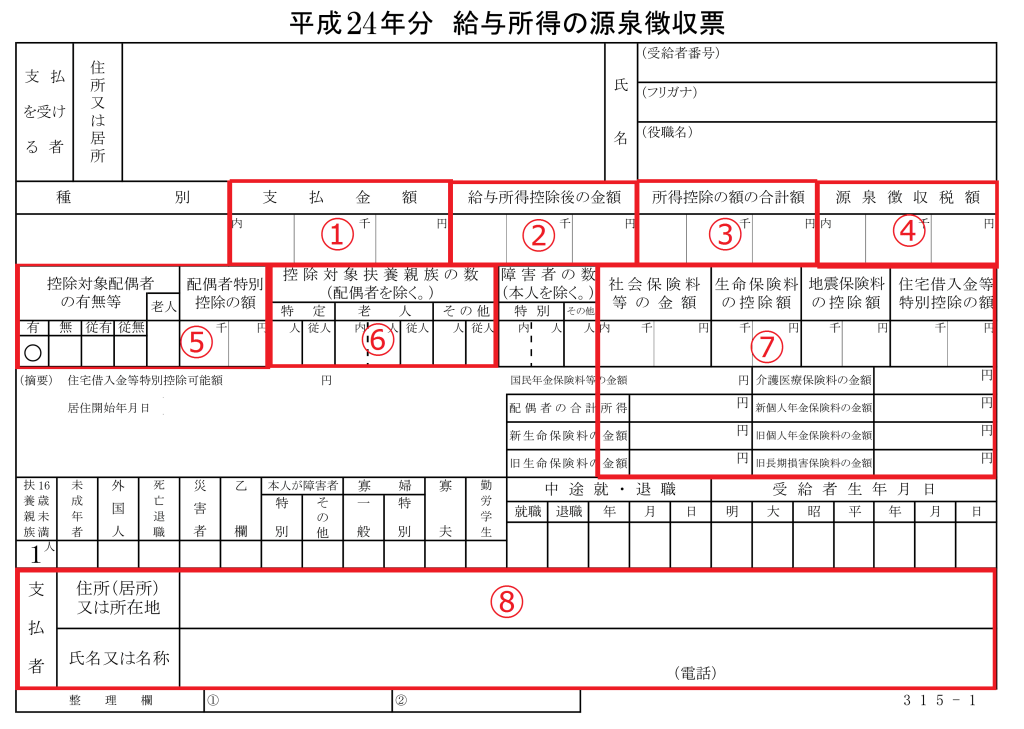
If paying tax in Japan, it is important to obtain a breakdown of such payments (Statement of Earnings) from your contracting organization.  If your visa type and nationality exempts you from paying Japanese taxes, the statement may also take the form of a kyuyo shiharai hokokusho. Be sure to keep your “Statement of Earnings” (源泉徴収票/gensen choshu hyo). JET participants who have to file tax returns in their home country need this, as do all reappointed JET participants who apply for an extension on their status of residence. Many contracting organisations provide a gensen choshu hyo in January. The gensen choshu hyo details your income, tax you pay, and how much you contribute to Social (Health) Insurance and Pension. Please confirm details regarding your gensen choshu hyo with your contracting organization.

*Statement of Earnings (源泉徴収票/ gensen choshu hyo)

1: Gross salary from January to December (including tax for those paying it in Japan)
2: Amount remaining after deducting tax exemptions from #1
3: Amount deducted based on Social Insurance and Life Insurance plans
4: Amount of income tax paid
5: Marital status and spousal exemption
6: Number of dependents
7: Amount of Social Insurance paid (Health Insurance and Pension Insurance)
8: Employer’s name and address

*The Tax Exemption Form
Those eligible for tax exemption in Japan should make sure they fill out forms for tax exemption. These can be downloaded from the National Tax Agency website at: http://www.nta.go.jp/tetsuzuki/shinsei/annai/joyaku/annai/pdf2/257.pdf

The tax exemptions do not come automatically. JETs must take the initiative to submit the forms for both years.

For US JET participants (ALTs), in order to be exempt from paying Japanese tax, IRS Form 6166 (certification of US residency for the year before participating on the JET Programme) must be submitted together with the Tax Exemption Form. Once file, the exemption will cover JETs for their first and second year. Please see the IRS website (www.irs.gov) for information on how to acquire Form 6166. The application for Form 6166 is called Form 8802. US ALTs must make every effort to acquire Form 6166 before coming to Japan. The IRS charges an $85 user fee to apply for Form 6166, which must be borne by the JET participant applying for the form. For more information please visit the JET Programme website on US Tax Exemption.

Note: Those who are exempt from income tax in Japan are exempt for two years only. From their third year, all JET participants (except those from China) are required to pay tax in Japan.

2. Local Inhabitant Tax

The Inhabitant Tax is calculated based on your previous January to December income in Japan and are levied by the municipality in which you reside as of 1 January of the current year. However, even when you are liable for taxes in your first year, inhabitant taxes are generally not required in the calendar year which you arrive. Therefore, if you arrived in July 2014, you will have inhabitant taxes due in 2015. The tax payment period is from June to May.

Tax liability for each JET depends on their nationality and the contents of any tax treaty between Japan and their country. JETs are responsible for their home country tax liabilities and your supervisor, contracting organization, PA, and CLAIR are not in a position to provide guidance on home country tax liability.

Visa Extension

The PAs cannot be held responsible for any issues you may face regarding your visas. The following information is for reference only and it is your own responsibility to clarify any doubts you may have with your local immigration services office.

If you are a reappointed 3rd-year JET going into your 4th year, you must apply for a visa extension before your current visa expires. Staying in Japan even a day after the expiration date is illegal. The procedure is straight forward but you will need to obtain some paper work from your Contracting Organization (for Muni JETs, this will be your respective Board of Education, for Ken JETs, this will be the Prefectural Board of Education: Kencho). Note you can only apply for your visa extension three months before the expiration date.

Visa Extension versus Period of Stay
Visa extension essentially refers to “extending your period of stay in Japan.”  When you first arrived and acquired your Residence Card, your period of stay is probably listed as three years. The visa extension process is to further extend that for an additional 1~3 years.

Required Documents

1. Current valid passport and current visa (旅券 ryouken): if your passport expired and you renewed it but still have your valid visa in your old passport, you’ll need both passports
2. Residence Card (在留カード zairyuu kaado)
3. Application Form: You can download the application form from the Japanese Immigration Office Website’s ’Application for Extension for Period of Stay‘ page. The form JETs use is under #3 Professor; Instructor, Language education at junior high and high school. Three pages must be filled out by you (in Japanese). Please check the example. The fourth page will need to be filled in by your Contracting Organization and inkaned as well.
4. 6,000 yen Revenue Stamp (収入印紙 shunyu inshi): This stamp can be obtained at the post office.
5. Other Verification Documents: This varies from office to office, but there is a possibility the Immigration Office may ask for other forms of verification regarding your employment, annual income or tax payment. Additional forms you could prepare are:

(a) Your contract and your certificate of employment (任用通知書 ninyou tsuuchi sho): The Certificate of Employment is an official document from your contracting organization certifying that you are in fact employed by them.
(b) Statement of earnings (源泉徴収票 gensen choushuu hyou),
(c) Inhabitant-Tax Certificate of Taxation (住民税の課税証明書 juumin-zei no kazei shoumeisho): This document verifies the amount of your inhabitant tax based on your income for one year from January 1st until December 31st.
(d) Certificate of Tax Payment (納税証明書 nouzei shoumeisho): This is a document verifying that you had no instances of non-payment on your levied inhabitant tax. Basically, this is proof that you paid your inhabitant tax (by virtue of having no non-payments).  You will have to go to your local government office for this form as well.


Procedures

Extending your period of stay is a two-part process. The request cannot be processed in one day. You’ll need to submit the required documents on the first day and pick it up a second day. The process cannot be done through mail.

First Visit

Bring your passport, residence card, and application form, a 40 mm x 30 mm photo to your local Immigration Office (Naha or Kadena) and apply at the Immigration Desk. Turn in everything to the Immigration Officer.  They will check your documents and put a stamp on your card stating you are in the process of applying for an extension.They may ask you to fill in a postcard with your name and address.  The postcard will be sent to you notifying your visa is ready for pick-up. The process may take up to 2 weeks.

Second Visit

Bring the postcard, 6,000 yen application fee, your passport, and residence card. Turn in everything to the immigration desk and they will finalize your visa extension. They will need to make you a new residence card so the process may take a while. They will not update the visa information in your passport so your residence card will be your visa. Make sure you carry it with your when traveling internationally. For KenJETs, the Prefectural BOE will only provide 1 year extensions of contracts so you will most likely only be able to get 1 year extensions. If you choose to stay a 5th year you will need to repeat the process again next year.

Good luck and please keep in mind, Visa Extension Application is the responsibility of the JET, so do not expect your contracting organization to do everything for you!


Returning JETs

For 3rd-5th year JETs finishing up your contracts, if you intend to stay in Japan for a few days/weeks after your contract you will need to change the status of your residency to a temporary visitor status. The documents and process is essentially similar to applying for a visa extension. You will need to submit the following documents:

1. Current valid passport and current visa (旅券 ryouken): if your passport expired and you renewed it but still have your valid visa in your old passport, you’ll need both passports
2. Residence Card (在留カード zairyuu kaado)
3. Application Form: You may also need to include a written explanation for you extension.
4. 6,000 yen Revenue Stamp (収入印紙 shunyu inshi): This stamp can be obtained at the post office.
5. Other Verification Documents: A document showing your last day of appointment (contract) and departure date (return ticket). You may possibly also need to show you have sufficient funds to stay in Japan during the requested extension time.

Insurance

CLAIR takes no responsibility for the accuracy of the information contained herein, nor will they accept responsibility for any financial loss incurred or any legal action taken against anyone (whether or not they are associated with the JET Programme) as a result of information contained in or omitted from this article. Please contact your nearest Social Insurance Office for the most up-to-date details.


All JET participants are covered under four types of insurance:

1. Japan Health Insurance Association-administered Social (Health) Insurance
2. Employee’s Pension Insurance
3. JET Accidental Insurance
4. Employment Insurance

1. Japan Health Insurance Association-administered Social (Health) Insurance

After you arrive at your contracting organization you will be given a blue health card. It is important to hold onto this card because you will need it for any medical visits. Under this insurance, 70% of your medical expenses will be covered for illness and injuries which means you are responsible for the remaining 30%.

CoveredNot Covered
Medical ExaminationsPreventative Medicine
Provisions of MedicinesUnnecessary Physical Check-Ups
Emergency TreatmentCosmetic Surgery
In-home Medical CareUnnecessary Dental Check-ups/Cleanings
Hospitalization and Nursing CareUnnecessary Eye Exams
Exams and Check-ups for normal pregnancies

It is mandatory for all JETs to enroll in this insurance policy. The insurance fees are withdrawn from your salary every month you are present in Japan. This means for Group A arrivals, you will be charged for your insurance coverage even for those few days you are present in Japan during July. This also means for Group B arrivals, you will be charged for the entire month of August at the end of your contract even though you are only contracted the first week. Thus all JETs will be charged the same amount.

2. Employee’s Pension Insurance

Enrollment in this policy is also a legal requirement. The Pension Insurance System will provide for you or your family in the event that you are seriously injured or die during the period you are making payments into the policy. After you finish your contract, you are able to apply for a Lump-Sum Withdrawal Payment as well as a Tax Refund to receive your pension insurance back. Please see Pension Refund for more details.

3. JET Accidental Insurance

After you arrived in Tokyo, you were given a small booklet and asked to fill out a form regarding this JET Accidental Insurance. This policy covers the treatment of illness and injury in Japan for everything not covered by the Social (Health) Insurance. Basically, this covers the remaining 30% of your medical expenses. This coverage is valid from the day you leave your home for Japan until when you return to your home country (after completing your contract) or April 30/ August 31.

Not Covered
Medical Treatment not recognized by the Social (Health) InsuranceLoss/Damage of personal belongings and household effects
Treatment of family members’ illnesses/injuriesTreatment for pre-existing illnesses/injuries before coming to Japan
Treatment received overseas for an illness/injury sustained in JapanDental Treatment
Over-the-counter medicine(s)Treatment received more than 180 days after the start of treatment
Treatment received more than 180 days after an injury caused by an accident

4. Employment Insurance

All foreign nationals (including JET Programme participants) working in Japan must enter the employment insurance program, regardless of nationality. Around ¥17,000–¥20,000 will be deducted from your salary per year.