JET Online Counseling Service

At the 2015 PA Conference, CLAIR announced a new online counseling service. This free counseling service works outside of CLAIR and JET. They offer two types of counseling: Web Mail Counseling and Skype Counseling

Web Mail Counseling is unlimited, although there is an individual thread-post limit so you may need to create multiple threads to continue your counseling discussion.  Skype Counseling is also unlimited, however availability depends on how many people are trying to reserve counseling sessions.  It is recommended to try Web Mail Counseling first.

To access the site you’ll need to register, but the information you enter on the site will not be reported to CLAIR, contracting organizations, or any other third party.  Your location is required for your counselor to better understand your situation.

CLAIR will provide all JETs with the master password and login information to the website. They ask that you do not share this information with any non-JETs or former JETs since it is only for current JET participants. Contact one of your PAs if you have any questions regarding the login procedure.

Web Mail Counseling: https://www.kokoro-soudan.net/en/
Skype Mail Counseling: https://www.fismec.co.jp/hiroba/en/secure/

Counseling & Support

During your stay in Okinawa, please feel free to discuss your concerns with your colleagues, supervisors, and other JETs. If you feel the need to reach out for any type of counseling or support, please look at our current list of resources below. It will be updated as we get more information. If you have or need any additional resources, please contact either one of the PAs.


AJET Peer Support Group

Website: ajetpsg.com

Phone: (050) 5534-5566
Skype username: AJETPSG
Hours: 20:00–1:00 (365 days a year)

These are trained JET volunteers who provide toll-free information, medical referrals and some counseling. It is completely confidential and anonymous. There are many ways to contact PSG, please check their website.


Japan Helpline

Phone: (0120) 461-997
Phone: (0570) 000-911
Website: http://www.jhelp.com

Call 24 hours a day, from anywhere about anything, from a simple question to natural disaster emergency assistance.


Ryukyu University Psychology Department

Phone: (098) 895-3331

English-speaking psychologists and psychotherapists are available here for professional consultation and counseling on an appointment basis.


CLAIR Information Desk

Phone: (03) 5213-1733
Email: gyomu@clair.or.jp
Hours: 9:00–17:45 (Monday–Friday)

The CLAIR Information Desk is run by JET Programme Coordinators (PC). PCs are all former JETs. They can be contacted by your contracting organization or host prefecture for consultation or assistance in finding professional counseling.


IMHPJ: International Mental Health Professionals-Japan

Website: www.imhpj.org

This site lists directory of mentail health therapists in Japan.


Japanese Society of Certified Clinical Psychologists

一般社団法人日本臨床心理士会<
Website: http://www.jsccp.jp/


TELL (Tokyo English Life Line)

Phone: (03) 5774-0992
Hours: 9:00–23:00 daily
Website: http://www.telljp.com/

TELL is a free, anonymous telephone counseling service offered all year long. This is a non-JET related service. They are trained volunteers who can offer counseling and support. Please visit their webiste for more information.

Airlines

International travel is not necessarily more difficult from Okinawa than from mainland Japan. Direct flights abroad leave to four countries from Okinawa’s Naha Airport: Taiwan, Korea, China and the Philippines. You may have to fly to Tokyo before departing for other international destinations, but JETs on mainland Japan are usually in the same situation. Naha’s airport is Japan’s fifth largest airport. It carries domestic flights to Tokyo Haneda Airport and has recently introduced flights to Tokyo Narita as well. There are also many other flights to cities on Japan’s four main islands, as well as to numerous destinations within Okinawa (Ishigaki, Miyako, and smaller islands).

One of the few setbacks of living on Okinawa is that mainland Japan is somewhat difficult to access. Whereas a mainland JET may be able to travel to Kyoto on the train during the weekend, OkiJETs have to fly, which is a substantial monetary expenditure. Keep in mind, however, that Okinawa is the top destination for tourists from mainland Japan! Within Okinawa, there are a plethora of weekend-accessible trips. There are many small islands just a few hours ferry ride away with pristine tropical beaches, and superb snorkeling and diving (all of these are available on the main island of Okinawa as well). There are also slightly more distant destinations within Okinawa such as Ishigaki, Iriomote, or Miyako (also huge tourist destinations) that we OkiJETs can access far better than those on the mainland.

It is always recommended to ask about nenkyu/holiday time before you book your possibly non refundable or changeable flights, especially if you will need to miss some classes. Travel times you may want to book in advance for or must be willing to pay a premium to travel during are Obon, summer vacation (the month of August), Golden Week, Silver Week and New Years. Much of the country has this time off and flights and trains are very busy both in Japan and going to and from other countries.

When you want to make an international flight, there are two routes.  One is to take an international flight directly from the Okinawa International Airport. The other way is to get a domestic flight to Fukuoka / Osaka / Tokyo, and transfer to an international carrier there. The Okinawa International terminal is pretty tiny compared with the domestic, and your options are limited.  Flights from the big mainland cities are cheaper, and fly to many more destinations; but given the time and expense of Japanese domestic flights, you are usually better off using Okinawa’s international terminal. The international destinations from Naha are Taipei, Seoul, Shanghai and Manila. China Air (via Taipei) isn’t the world’s most glamourous carrier, but they are reasonably cheap, and fly twice a day, and from Taipei you can transfer to flights to Thailand, Europe, Australia and the U.S. It is also possible (and slightly cheaper) to use Phillipine Air to travel to Australia, or Asiana Air (via Seoul) to Europe, but flights are limited. Also, remember to check different travel agents, as the prices for the same flight may vary by 5000 yen or more.  HIS, HIT and OTS all have English-speaking staff.

There are two major airlines in Japan: JAL and ANA. They fly nearly identical routes at different times and their prices are almost always the same. Air tickets are sold as one-way in Japan so it’s possible to fly from Naha to Osaka with ANA and back with JAL if one has more convenient times than the other. Both have easy to navigate English websites.

If you’re planing on doing lots of travel within and outside Japan while here, consider getting both JAL and ANA’s mileage cards. The applications are online and are fast and simple to complete. You’ll get the cards in the mail and can use them at airport to printout your e-ticket reservations. JAL and ANA are also partners with other airlines and numerous hotels so that you can earn mileage even when not flying with them. ANA, for example, is a part of the Star Alliance which includes AirNewZealand, Lufthansa, BMI, Asiana, United, AirCanada and others. JAL also offers a credit card and you can request the application for it when filling out the mileage card form.


Japan Airlines (JAL)

JAL flies to and from more cities on mainland Japan. JAL recently introduced 28 Day advanced fare purchase or Sakitoku fares, and Super Sakitoku or 45 Day advanced purchase for more budget minded passengers. They also have a companion fare if you are traveling in a group of 2 to 4 passengers, allowing for a better rate.

The JAL English website looks good but only offers schedules of flights and not the actual fares. It’s good to use as a comparison for the ANA flights if you’re looking for specific flying times. It will also show if any tickets are available for the flights you want. You can search for fares on the Japanese version of the site, so you’ll need to familiarize yourself with the kanji for your destinations, but the rest is similar to the English site layout. Also to find out prices or to reserve with JAL you’ll have to call the numbers available through the website or stop by a travel desk at your nearest Jusco.


All Nippon Airlines (ANA)

On the ANA website you can search for fare prices 2 months prior to the departure date. All prices are one-way fares, and ANA has at least cheap specials to watch out for. ANA’s cheapest fares are Chowari and they are only available during specific buying and flying windows. There are a limited amount of seats available on each flight at Chowari prices, so book on the first day the fares become available. Chowari fares will also not be during any holidays or long weekends.

The other cheap fare for ANA is Tabiwari. It’s available 2 months prior to departure and up to 28 days prior to departure. In some instances the Tabiwari fare may be as cheap as chowari fare and it’s available year round. This is a replacement for the Birthday fare that was popular but is no longer available.

ANA is also continuing to expand it’s network. It recently begun direct flights to Sapporo (best to keep that in mind for the Yuki Matsuri in February!).

It’s possible to reserve without paying on the ANA website. The reservation will hold for 2 days. You can pay at a Lawson or FamilyMart or with a credit card. Paying at a convenience store is easy to do; follow the links on the website once you’ve completed your reservation and you’ll be shown the step by step with pictures instructions on how to pay at a convenience store. Reserving online also gives you a 2% discount. It’s not much, but it’s something and also makes check-in at the airport speedy.

Recently ANA has started a “SKIP” program which allows you to select you seat online to avoid a check-in at the airport as well and head straight to the gate.


Skymark

Flights direct from Naha to Tokyo Haneda, Kobe (easy access to Osaka and Kyoto), Fukuoka and Nagoya Chubu. Flights can be as cheap as 10,800円 one way, including taxes and fees if you book two months out and get in on the limited seats available at that price. Flights go on sale two months before departure date at 9am. The cheapest flights have no change fees, but you can refund your seat if you need to.

Payment options include credit cards and cash. The easiest way is paying at a FamilyMart or Lawsons, and there are directions on their website to help you use the terminal to do so. You have two days once you book a flight to pay for it, then another two days to pay for it if you want to pay cash at a conbini.


Jetstar

Jetstar flies from Naha to Sapporo, Fukuoka, Osaka, Kagoshima, Matsuyama, Tokyo, Oita and Takamatsu within Japan. This airline also flies to Australian aiports such as Brisbane, Cairns, Darwin, Melbourne, Gold Coast, and Sydney. You can also fly to New Zealand (Auckland), the Phillipines (Manila), Taiwan (Taipei) and Singapore with this airline. Most bookings require a credit card, though!


Peach

Peach has become a very convenient option for those willing to give up a few minor luxuries; the Peach terminal is separated from the main airport and requires a shuttle bus, one has to have their ticket pre-printed, and one has to walk right up to the plane, but other than that there aren’t very many pitfalls. Peach flies from Naha to Osaka and Ishigaki, as well as Taiwan(Taipei). Recently Peach has also expanded to direct flights to Korea.


Vanilla Air

The newest airline to add themselves to the list is Vanilla Air. The options are a bit limited at the moment as the only flight from Naha is to Tokyo, but from Tokyo you can fly to Sapporo, Taipei and Seoul! Very nice.


HIS Travel Okinawa

For more complex travel plans or for package vacations which can save you a lot of money, HIS Travel is recommended. They have two offices with English speaking staff, and have a website with discount fare prices to and from destinations all over Asia and to North America. They even do packages to some of the Okinawan Islands if you find that intimidating to do on your own. They can also help you book tickets on airlines like Skymark if you do not want to fuss with conbinis and online bookings. There is an office in Chatan as well as Okinawa City.


If you’re worried about traveling overseas look into getting some travel insurance. Here are some options:

SBI Insurance (online, Japanese only)

Happy Flying!

Airport Routes

Naha International Airport (airport code OKA), located in its namesake in the capital city, is an OkiJET’s only real means of air transport. However, with its lack of trains and sometimes-unreliable public transport, getting to this lone airport can be something of a logistical nightmare. Collected here are every current known method of getting to the airport and, just as importantly, getting back.

Naha Airport Address:
150 Kagamizu, Naha, Okinawa Prefecture, Japan ‎


Method 1: By Car

If you happen to live on the main island itself, you have the option of driving to the airport, easily the most convenient. However, car storage is the price you’ll have to pay, unless you have a friend willing to drive you down and pick you up.

Parking at the Airport
Parking is available at the airport, but is very limited and as such has a good chance of being full. The parking structures in front of both the Domestic and International terminals (the multilevel garages, not the un-covered lots!) charge ¥1000 per day, which may be fine in the short term but quickly adds up. If your trip is more than a weekend, you may want to consider the following alternative.

Honest Naha Airport Parking Service (098-891-8670)
Honest Parking Service is a car storage facility located less than five minutes from the airport proper, and is an excellent (and much cheaper) way to store your car during your trip. Prices slide depending on length of stay.

Call ahead to make a reservation (three days early is preferred, more during peak seasons), and they will ask for your flight numbers and departure dates. They will tell you which ‘departures’ gate to park at the day of your flight, where an attendant will be waiting for you. They will have you sign some papers and have you pay ahead of time, then hand you a receipt and take your keys.

When you return, give them a call at baggage claim. They will have your car waiting for you (often washed, free of charge) at the arrivals stop they direct you to. The staff are pleasant, timely, and speak excellent English.

Prices (August 2013)
3 nights / 4 days¥2800
6 night / 7 days¥4500
9 night / 10 days¥6000
18 days – 1 month¥10000

Method 2: By Bus

The bus may be the longest and least convenient method of transport (especially with luggage, or during rush hour!), but it is easily the cheapest. Many bus lines are connected to the Naha Bus Terminal (那覇バスタミナール), and their time tables will be listed on their respective websites. Simply find the nearest stop to your house, look up the bus number, and check the stops.

These website, in particular, is extremely helpful in looking up which bus lines and routes service your local stop. Though it’s entirely in Japanese, the only kanji you need to be able to recognize are your city name and bus stop. Please note that it doesn’t provide timetables – you’ll need to look those up on the company websites.

Okinawa Bus Stop Lookup Service (Japanese)
Toyobus (Japanese)
Okinawa Bus (Japanese)
Bus Kotsu Airport Area Service Map (English)

Once you have reached the bus terminal, you can either continue on to the Airport bus station (Naha Kūkō Kokunaisen 那覇空港国内線) or take the monorail (often the faster option) as explained below.


Method 3: By Monorail

The Naha Monorail, in a stroke of brilliant urban planning, has a station that deposits you directly in front of the main airport terminal. The name to look for is Naha Kūkō Eki (那覇空港駅) on the timetables. Even more conveniently, the Naha Bus Terminal is directly beside Asahibashi (旭橋駅) station. Trains run from 6am to shortly after 11pm every day, and tend to come every 10-15 minutes.

If you live or will be in the Naha area, all monorail stations are brightly labeled with monorail icons on Google Maps, and you can easily find the nearest one.

Naha Monorail Website (Japanese only)
Station Timetables


Method 4: By Taxi

This is, by far, the most expensive method of travel. A one-way trip from the Kadena area to Naha starts at ¥5000, and from Nago to Naha starts at ¥22000. If, however, you live reasonably close or are traveling in a group, the fare may be infinitely more manageable.

Okito Taxi 098-946-5005 (English Spoken)
Meiho Taxi 098-937-2467 (English Spoken)
Sanyo Taxi 098-898-7027 (Japanese Only)
Futaba Taxi 098-898-2028 (Japanese Only)
Toho Taxi 098-936-6393 (Japanese Only)


Method 5: By Ferry

If you are on an outer island, you will first need to trek to the Okinawa mainland, either the day of or the day before your travel.

The following islands have airports:

AguniIshigakiMinamidaito
FukajiKitadaitoMiyakojima
IejimaKumejimaYonaguni

Many outer islands also have local ferries to the main island, usually at either the northern or southern points. The southern port, Tomari Wharf (or ‘Tomarin’), is a five-minute walk from the Miebashi (美栄橋駅) monorail station.

Combating Summer

Overview

The Okinawan heat could be best described as immediately sweltering. If you are not used to heat and humidity, it can be quite overwhelming at first. In addition to trying to keep comfortably cool, the summer season also brings a host of unwelcome visitors in the form of moisture, mold, and pests. All of the items and products listed below can easily be obtained at your local supermarket, drugstore, or online through Amazon.

  1. Regarding Sweat
  2. Regarding the Sun
  3. Regarding Heatstroke
  4. Regarding Air-Conditioning
  5. Regarding Moisture
  6. Regarding Mold
  7. Regarding Pests and Insects

Regarding Sweat

Due to the high humidity, sweating is unavoidable for most of us. Although it might seem strange at first, all Japanese carry around a small hand towel. This hand towel serves the dual purpose of dabbing off sweat and drying your hands after you wash them (paper towels are not available in all restrooms). In addition to a hand towel, there are many other products available to help you cool off in the summer months.

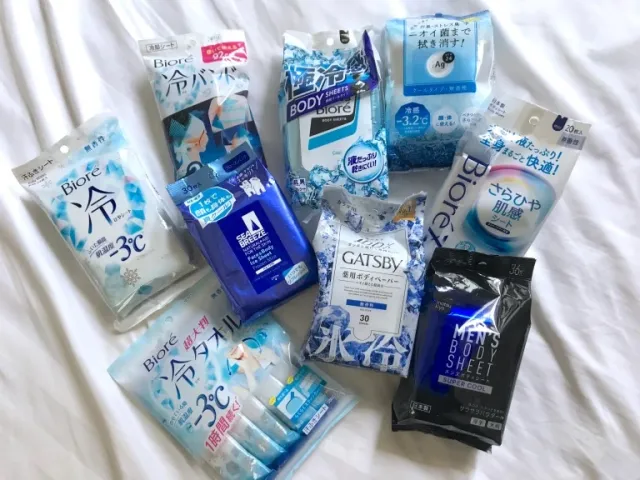
Face and body wipes

Gatsby and Biore both make cooling wipes that can be used all over the body. Most of these wipes contain menthol, so be careful when using them around your eyes, nose, and mouth. Some of these wipes promise to lower your skin temperature in the wiped area by three degrees. Because of this, these wipes can be quite intense and cause a mild burning sensation. When testing out which wipe will be most effective for you, please dab in sensitive areas.

Hand Fans

Sensu, folding hand fans, and uchiwa, flat hand fans, are common accessories. Recently, electric hand fans have also become quite common. Finding one that can fit in your bag or at your desk is highly recommended.

Regarding the Sun

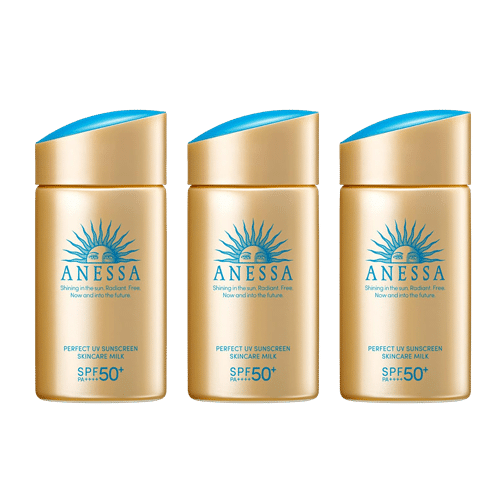
In addition to the heat and humidity, Okinawa also has an extremely high UV index, meaning that the intensity of the sun’s rays can cause damage to your skin. To ensure your skin is protected, it is recommended that you always wear sunscreen (hiyake dome ひやけどめ 日焼け止め) and reapply it often. Many Okinawans will also wear a hat and use an umbrella when outside for long periods.

Sunscreen Recommendations

  • ANESSA Perfect UV Skincare Milk
    • Lightweight sunscreen that contains skincare ingredients and prevents sand from sticking to your skin
  • Biore UV Aqua Rich Watery Essence
    • Lightweight and long-lasting sunscreen
  • SKIN AQUA Tone Up UV Essence
    • A lightweight sunscreen that also has color-correcting properties (the pink packaging smooths out skin to give an overall brightening effect; the green packaging helps reduce the appearance of redness)

Regarding Heatstroke

Due to the high humidity levels in Japan, heatstroke is a common illness that hospitalizes 50,000 people every year. While those over 65 years of age and those with chronic illnesses are more susceptible to heatstroke, everyone should take preventative measures as well as familiarize themselves with the symptoms. Heatstroke can occur from both prolonged exposure to high temperatures and humidity as well as from strenuous activity.

Heatstroke Symptoms

  • High body temperature
  • Altered mental state or behavior
  • Lack of sweat
  • Nausea and vomiting
  • Flushed skin
  • Rapid breathing
  • Racing heart rate
  • Headache

Heatstroke Treatment

  • Call 119, the emergency medical number.
  • Get into the shade or indoors.
  • Remove excess clothing layers.
  • Use any means available to cool off (water, cooling body wipes, a fan, etc.).

Heatstroke Prevention

  • Wear lightweight, loose fitting clothing.
  • Wear sunscreen and reapply it often.
  • Stay hydrated (suibun hokyu すいぶんほきゅう 水分補給)
    • In addition to water, Pocari Sweat, Aquarius, and fruit juices are great ways of keeping hydrated.
    • Limit diuretics, such as alcohol and caffeine.
  • Take it easy between 10 AM and 3 PM, when the sun is at its strongest.

Heatstroke can be a life-threatening emergency. If you believe you are experiencing heatstroke, seek immediate medical attention.

Further Information:

Heatstroke – Symptoms and causes – Mayo Clinic

Naha, Okinawa | Heatstroke Risk Information | NHK WORLD-JAPAN

Regarding Air-Conditioning

Due to the high humidity, airconditioning is fairly common in Okinawa. Most apartments will come equipped with a wall unit. If your apartment is not equipped with a unit, please talk to your coordinator and apartment rental agency about purchasing and installing a unit. If you have a unit, here is some basic information about using and caring for your unit:

Cleaning

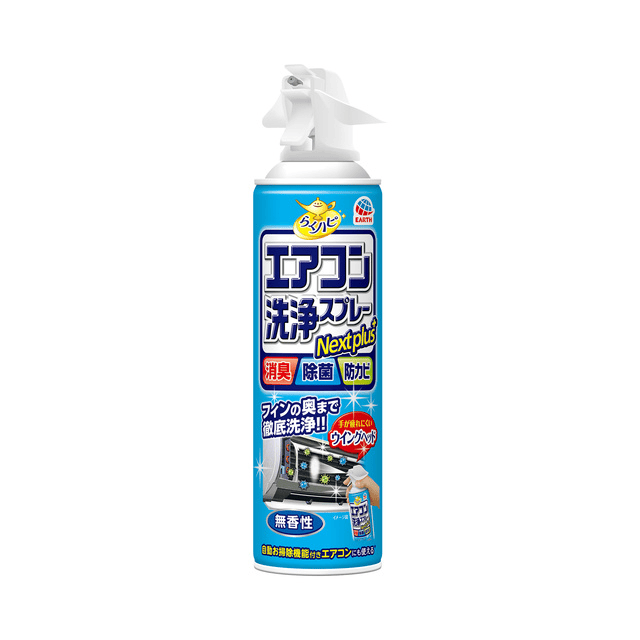
It is recommended that everyone cleans their air-conditioning unit once a year during the spring to ensure that the unit will run efficiently during the summer months. If you do not feel up to the task of cleaning the unit yourself, there are many professionals who offer this service.

To clean the unit yourself, follow these basic steps:

  • Buy air-conditioner cleaner
  • Unplug the unit
  • Remove the inside filter and clean it (outside as it is dusty)
  • Apply the cleaner following the instructions on the can
  • Reassemble the unit
  • This site offers a step by step guide in English with pictures: Cleaning Your Air-Conditioning Unit.

Air-Conditioner Settings

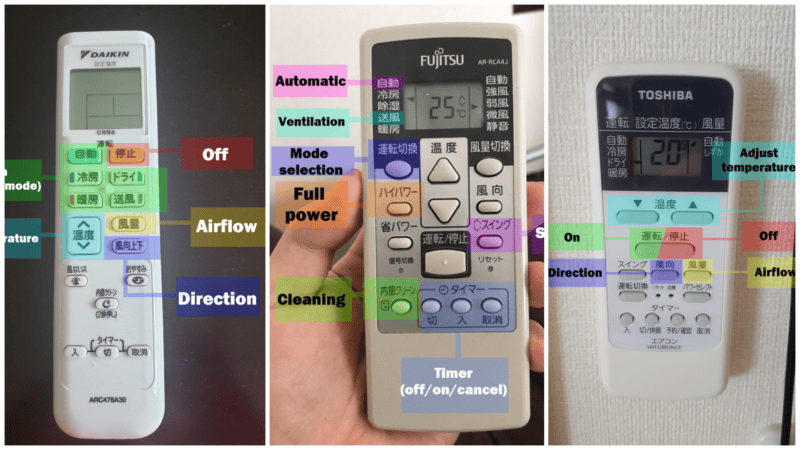
While everyone’s remote control may differ in appearance, every unit is capable of three basic settings: cool, dry, and heat.

  • Cool (reibo れいぼう 冷房)
    • This is the setting that you will probably use the most on your unit. As tempting as it may be to set your unit to 20℃ (68℉), please note that the optimum temperature for cooling and efficiency is around 24℃ (75℉).
    • Many OkiJETs are surprised when they receive their first electricity bill in the summer. If you run your unit at a low temperature 24/7, please note that your electricity bill for the month can be upwards of ¥10,000.
  • Dry/Dehumidification (dorai ドライ, joshitsu じょしつ 除湿)
    • While the cool setting is great and produces a more immediate effect, the dry/dehumidification setting is also worth trying. This setting reduces the amount of moisture in the air and does not require as much energy as the cool setting, making it a more cost effective option.
    • In addition to using this function for cooling purposes, it is also a great setting to use during the rainy season to help dry laundry hung inside.
    • Please note that ideal running time in this setting is an hour to two hours. Running it for too long can cause the air to become uncomfortably dry.
  • Heat (danbo だんぼう 暖房)

Regarding Moisture

While moisture is a problem during the sweltering days of summer, it is especially noticeable during the rainy season. On muggy days, moisture tends to collect and pool on things such as your fridge/freezer, windows, doors, walls, and even under beds/futons. Because everyone’s apartment differs, we recommend waiting for a muggy day and checking for moisture build-up in the common places listed above. Make note of which places collect moisture and lay a towel or newspaper down to collect moisture build-up during the day.

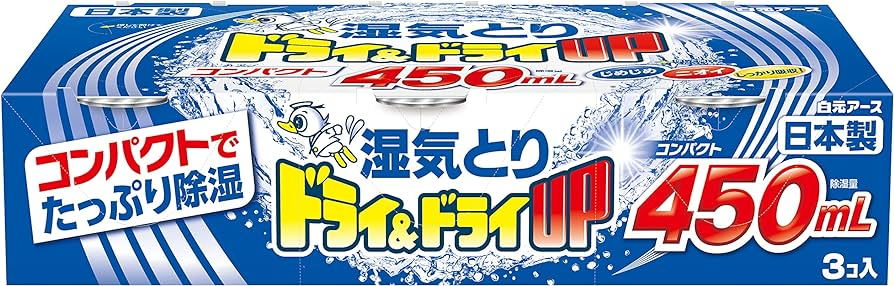
  • Dehumidifying Containers (kansozai かんそうざい 乾燥剤; shikketori しっけとり 湿気取り)
    • These little plastic containers hold a dehydrating agent that helps prevent moisture build-up in enclosed spaces, such as drawers, closets, shoes, pockets, cupboards, and the wash closet/toilet.
    • To store your winter clothes and bedding, carefully fold them into a plastic bag along with a few shikketori packets.
  • Antifungal Lining (bokabi bochuzai ぼうカビぼうちゅざい 防カビ防虫剤)
    • When used to line your drawers, this lining prevents mold formation as well as acts as a dust mite repellent.

Regarding Mold

Mold (kabi かび 黴) thrives in moist environments and produces spores that can be damaging to one’s health. While mold spores can be especially dangerous to the elderly and those with compromised immune systems, mold can cause respiratory problems in otherwise healthy people. Mold grows in moist places, such as the bathroom, the kitchen, and other high-moisture areas. Mold can appear as a discoloration, a dark spot, or a fuzzy spot. Mold also causes a musty smell. Here are some recommendations to prevent and fight mold growth:

Products

  • Sodium Bicarbonate (tansan suiso natoriumu 炭酸水素ナトリウム)
    • Commonly known as baking soda, sodium bicarbonate can also be used to kill mold without harsh chemical effects.
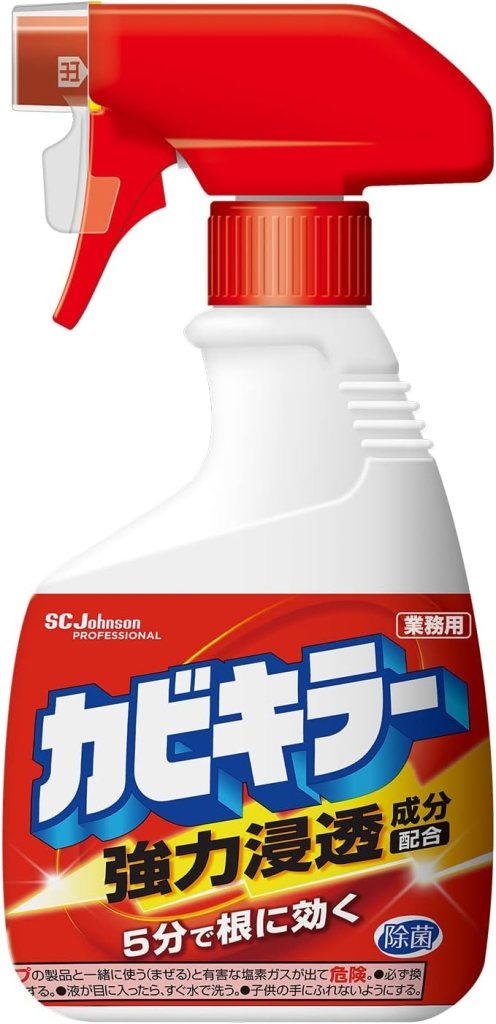
  • Kabi Killer カビキラー
    • This spray can be found in most drug stores and supermarkets. Please be sure to wear gloves and a mask when handling it. Do not mix this spray with any other products.

Mold Prevention

Proper ventilation can greatly reduce mold growth. Open doors and windows after showering and cooking to increase airflow. Run exhaust fans. Reducing and keeping humidity levels low will also keep mold from forming. If needed, a hygrometer (humidity meter) can be purchased online through Amazon. Ideal humidity in a home is around 45%.

Tatami Mats and Futons

If you have tatami mats and/or a futon, please be sure to familiarize yourself with proper care routines. While tatami mats are elevated, your futon can collect moisture where it rests against the tatami. It is recommended that you carefully fold and put away your futon every morning. On sunny days, many Japanese people will take their futons outside and beat it with a futon tataki (布団たたき), a specially designed stick that releases dust mites and other allergens. You can also take your futon to a dry cleaning store for a deeper clean.

Regarding Pests and Insects

Depending on the area in which you live, some pests and insects will be more common than others. When you have unwanted visitors in your home, try out some of the following remedies:

For Cockroaches (gokiburi ゴキブリ):

Cockroaches in Japan tend to be big. They can enter from a variety of places including the crack under the door, kitchen drains, bathroom drains, windows, and other similar spaces. Regular spraying and cleaning can help keep them away. Be especially careful during the rainy season as cockroaches thrive in high humidity.

  • Gokiburi hoi hoi
    • This roach trap is shaped like a house that you simply assemble and leave out. When a cockroach gets stuck on the trap, you can simply toss it in the garbage.
  • Hosan Dango
    • Made from boric acid and onions, this bait will kill any indoor cockroaches.
  • Barusan
    • This is an insecticide bomb that requires you to vacate your apartment for four hours after use. As this is quite powerful, it will kill a variety of insects.

For Mites, Fleas, and Ticks (dani ダニ)

While mites are not generally hazardous, their bites can be persistent and quite itchy. Here are some prevention tips and products:

  • Washing and Hanging
    • Mites are sensitive to UV light, so washing and then hanging your bedding outside is an easy, natural way to eliminate them.
  • Dani Asu
    • Use this product on your tatami mats by inserting the needle and spraying in several places
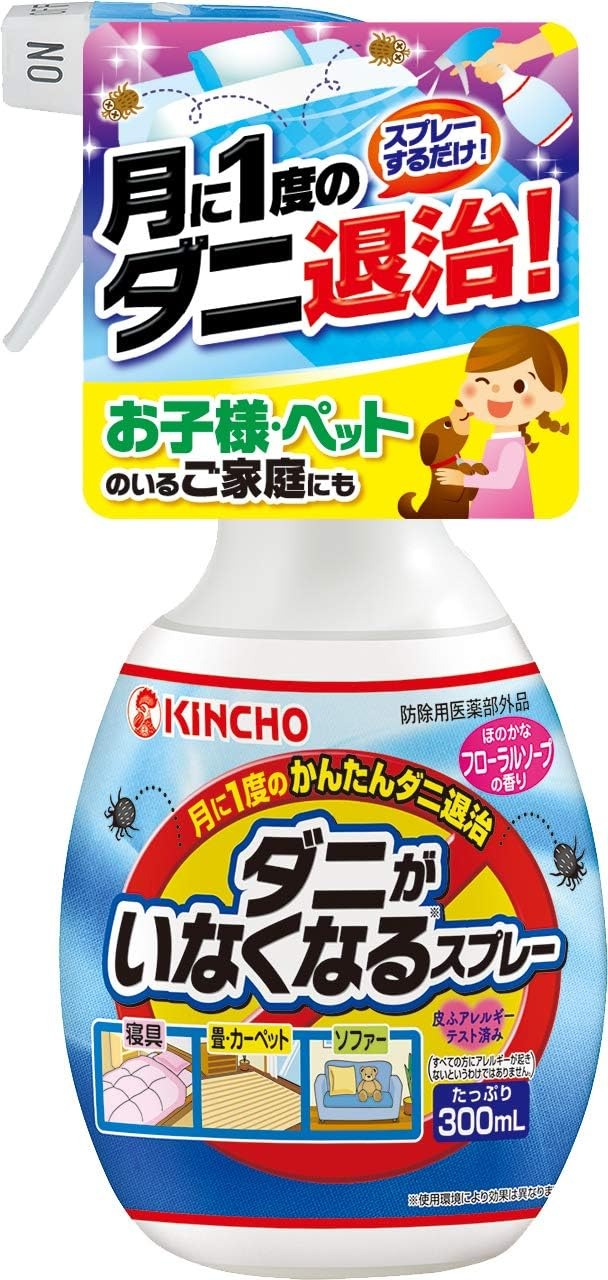
  • ダニがいなくなるスプレー (Mites Begone Spray)
    • This spray can be used once a month on tatami mats, mattresses, fabric sofas, and other soft surfaces.
  • Dani Corners
    • This is a flat repellant sheet that slips underneath bedding
  • Dani Taiji
    • This is another spray type that lasts about 7 days

For Mosquitoes (ka  か 蚊)

Depending on your area, mosquitoes may be more prevalent. Construction sites can stir up batches of them, so be careful around those spots.

  • Herb Mushiyoke
    • This is a room deterrent with a soft scent.
  • Saratect
    • This is a spray repellent that also works on dust mites. It can be used on both bedding and skin.
  • Skin Vape
    • A water-based repellent, Skin Vape is a nice smelling spray that can be used by both children and adults.
  • Skincare Aqua Guard
    • This mist repellent comes in a small can and is easy to carry around.

For Lizard and Geckos (yamori やもり 家守)

While lizards and geckos are not hazardous and do eat other insects, they can be quite unwelcome in an apartment. They often slip in through cracks in the window or doors. It may be hard to spot a well-hidden one, but they can easily be identified through the unique laughing sound they make in a silent room.

  • Broom and Container
    • The best way to remove an unwanted lizard or gecko is to capture it. Because they can be quite fast, it is best to get it on an easily accessible, flat surface. When there, use a large container to quickly trap it against the wall and then take it outside. Release it far away from your apartment if you do not wish to see it again.
  • Gokiburi hoi hoi
    • If you cannot trap a lizard or gecko, a passive option would be to use a roach trap. If the lizard or gecko gets caught in the glue, simply toss out the trap in the garbage.

For Insect bite relief

  • Muhi S
    • This anti-itch cream comes in a small tube and leaves no residue. It is also available in liquid.
  • Kinkan
    • This liquid anti-itch medicine comes with a sponge applicator so it can be easily rolled onto the affected area.
  • Unakowa Cool Punch
    • This anti-itch liquid is applied via brush and gives a cooling sensation to the applied area.

Image Credit: 1, 2, 3, 4, 5, 6, 7, 8, 9, 10